 Skip-the-line available
 The History of Himeji Castle
From a 14th-century hilltop fort to Ikeda Terumasa's 1609 white keep — and how the castle survived war, earthquake and four centuries intact.
The Himeji Castle you climb today is essentially a single man's vision, completed in 1609 — but it stands on nearly three centuries of earlier fortification, and it has outlived almost everything that should have destroyed it. Where most of Japan's celebrated castles were burned, demolished in the Meiji era, or flattened in 1945 and rebuilt in concrete, Himeji's wooden keep has never once been destroyed. It came through the air raids that levelled the surrounding city, through the great earthquake of 1995, and through a 20th century that erased so many of its peers. This guide traces that survival: from a small hilltop fort raised by the Akamatsu clan, through Toyotomi Hideyoshi's keep and Ikeda Terumasa's vast rebuild, to the restorations that keep the White Heron white.
Origins: the Akamatsu fort, 14th century
Himeji's story begins on the low hill of Himeyama, where in the 1330s the warrior Akamatsu Norimura is recorded as raising a fort during the turbulent wars between rival imperial courts. Around 1346 his successors rebuilt it as Himeyama Castle, and over the following two centuries the site passed through the hands of the Akamatsu and their vassals as the strategic key to the western approaches of the Kansai plain. These early structures were modest by later standards — earthworks and timber halls on a defensible rise — and nothing of them survives above ground today.
The transformation toward a major castle began in the mid-16th century. By 1561 the warlord Kuroda Shigetaka had remodelled the hilltop works into something recognisable as Himeji Castle, and the Kuroda family held it as a strongpoint in the wars that were slowly consolidating control of the region. It was still a fortress of its age — built for a world of clan warfare rather than the grand, settled domains that would follow — but its commanding position on the road west had been firmly established, setting the stage for the men who would rebuild it on a far greater scale.
Hideyoshi's keep, 1581
In 1580 the great unifier Toyotomi Hideyoshi took control of Himeji as a base for his campaigns to subdue western Japan, and the following year, in 1581, he expanded the castle and raised a three-storey keep on the hill. This was the first true tower keep on the site — a statement of the new, centralising power that Hideyoshi represented as he and his lord Oda Nobunaga broke the old patchwork of warring clans. From Himeji, Hideyoshi pushed his armies further west, and the castle became a working command post in the unification of the country.
Hideyoshi's keep was far smaller than the tower that stands today, and it did not last; it was superseded a generation later in the great rebuild. But the choice of Himeji as a fortress worth a major keep was decisive. After Hideyoshi's death and the climactic battle of Sekigahara in 1600, the victorious Tokugawa Ieyasu rewarded his son-in-law and ally Ikeda Terumasa with the Himeji domain — and Terumasa, secure in Tokugawa favour and astride a vital route west, set about replacing Hideyoshi's modest tower with one of the largest castles Japan had ever seen.
Ikeda Terumasa's rebuild, 1601–1609
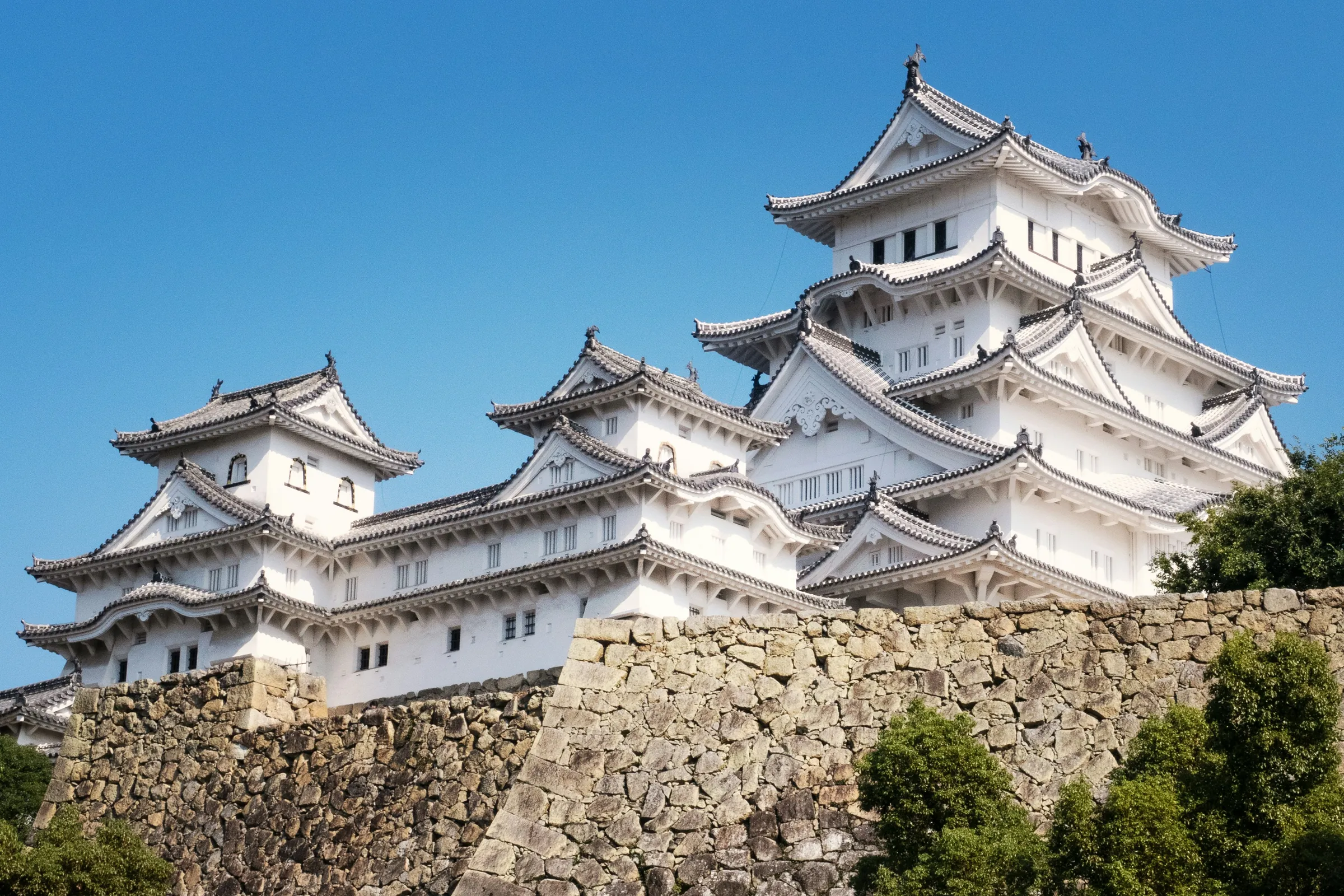
Between 1601 and 1609 Ikeda Terumasa rebuilt Himeji almost entirely, creating the castle essentially as it stands today. The project was vast — by one estimate it consumed some 2.5 million man-days of labour — and produced a 'linked keep' complex: a great main keep of six interior floors and a basement, joined by corridors and gates to three smaller subsidiary keeps, all set within a spiral of baileys, walls and gates engineered to confuse and trap an attacker. The whole was coated in the brilliant white fire-resistant plaster that gave the castle its name, Shirasagi-jo, the 'White Heron Castle'.
A few years later, after the final fall of the Toyotomi at Osaka in 1615, the lord Honda Tadamasa added the Nishinomaru, the west bailey, for his son and his daughter-in-law Princess Sen, completing the complex much as visitors see it now. Himeji was inscribed by UNESCO as a World Heritage Site in December 1993 — among Japan's very first — and recognised for exactly this: a near-complete network of 83 surviving structures, the finest intact example of early-17th-century Japanese castle architecture, built at the high point of the form just before the long peace of the Edo period made such fortresses obsolete.
The castle that war never destroyed
Himeji's most remarkable achievement is simply that it survived. Many of Japan's castles were dismantled in the Meiji period after 1868 as feudal relics, and Himeji was nearly sold for demolition before being spared. Far worse came in 1945, when American air raids burned much of the city of Himeji to the ground in the closing months of the Second World War. The castle stood in the middle of it — and survived. By a famous chance, a firebomb is said to have fallen onto the top floor of the keep and failed to explode, and the white tower came through the destruction of its own city essentially untouched.
Half a century later the castle was tested again. The Great Hanshin earthquake of January 1995 devastated nearby Kobe and shook the whole region, yet Himeji's keep — its timber frame flexing as its builders intended — came through without structural damage, even as a small bottle of sake reportedly left on an altar inside survived unbroken. Between its near-demolition, the firestorm of 1945 and the earthquake of 1995, Himeji has earned its reputation as a building that simply will not fall. It is this unbroken survival, as much as its beauty, that makes standing inside the original 1609 keep so moving.
The Heisei and 2009–2015 restorations
Surviving is not the same as standing still, and a 400-year-old wooden building in a damp climate needs constant care. A major programme of conservation through the late 20th century — the 'Showa' and 'Heisei' repairs — dismantled, recorded and rebuilt parts of the structure to keep the timber sound, replacing decayed members while preserving the original design. This painstaking, reversible approach to repair is part of why UNESCO regards the castle as so authentically preserved: it is maintained, not reconstructed.
The most recent and most visible work ran from 2009 to 2015, when the keep was wrapped in scaffolding for a thorough restoration of its roof and plaster. The roof tiles were renewed and the white lime plaster re-coated across the walls, eaves and tiles, returning the keep to a startling brightness when it reopened on 27 March 2015 — so white that some nicknamed it 'the white egret castle' before the colour mellowed slightly with weathering. The result is what you see today: a genuinely old castle kept in genuinely fine condition, the White Heron restored to its proper plumage.
Frequently asked
How old is Himeji Castle?
The present keep was completed in 1609 under Ikeda Terumasa, but the site was first fortified in the 14th century by the Akamatsu clan. So the castle you climb is over 400 years old, on a hill fortified for nearly seven centuries.
Who built Himeji Castle?
The castle as it stands today was built by Ikeda Terumasa between 1601 and 1609. It stands on earlier forts begun by the Akamatsu clan in the 14th century and a keep raised by Toyotomi Hideyoshi in 1581; Honda Tadamasa later added the west bailey.
Is Himeji Castle original or a reconstruction?
It is original. Unlike most famous Japanese castles, whose keeps are 20th-century concrete rebuilds, Himeji's wooden keep was completed in 1609 and has never been destroyed — making it the country's finest surviving original castle.
How did Himeji Castle survive World War II?
American air raids burned much of the city of Himeji in 1945, but the castle survived. By a famous chance a firebomb is said to have landed on the top floor of the keep and failed to explode, leaving the tower essentially undamaged.
Why is Himeji Castle a UNESCO World Heritage Site?
Himeji was inscribed in December 1993 as one of Japan's first World Heritage Sites. It is recognised as the finest intact example of early-17th-century Japanese castle architecture, with a near-complete network of 83 surviving structures.
When was Himeji Castle last restored?
The most recent major restoration ran from 2009 to 2015, renewing the keep's roof tiles and re-coating its white plaster. The keep reopened on 27 March 2015, dazzlingly white before the colour mellowed with weathering.
Why is it called the White Heron Castle?
Its Japanese name, Shirasagi-jo, means 'White Heron Castle'. The brilliant white fire-resistant plaster covering its walls, eaves and roof tiles, and the way its roofs spread like wings, make it resemble a heron taking flight. The plaster also helped it survive fire.