 Skip-the-line available
 What to See at Himeji Castle
The six-storey keep, the maze of gates, Princess Sen's west bailey and the gardens next door — the highlights of Japan's finest original castle.
Himeji Castle is not a single building but a fortress, and the order in which you walk it is the order in which it was designed to defeat an attacker. You climb from the outer gates through a spiral of walled courtyards, slip your shoes off at the base of the keep, and ascend six floors of bare dark timber to a window over the whole city. Along the way are a thousand loopholes cut for archers and gunners, windows built to drop stones on intruders, a 300-metre corridor where a princess's servants lived, and a quiet enclosure with a grim reputation. This guide walks you through the highlights in roughly the order you meet them — the keep, the defences, the west bailey, and the garden next door that gives the best view of all.
The six-storey main keep
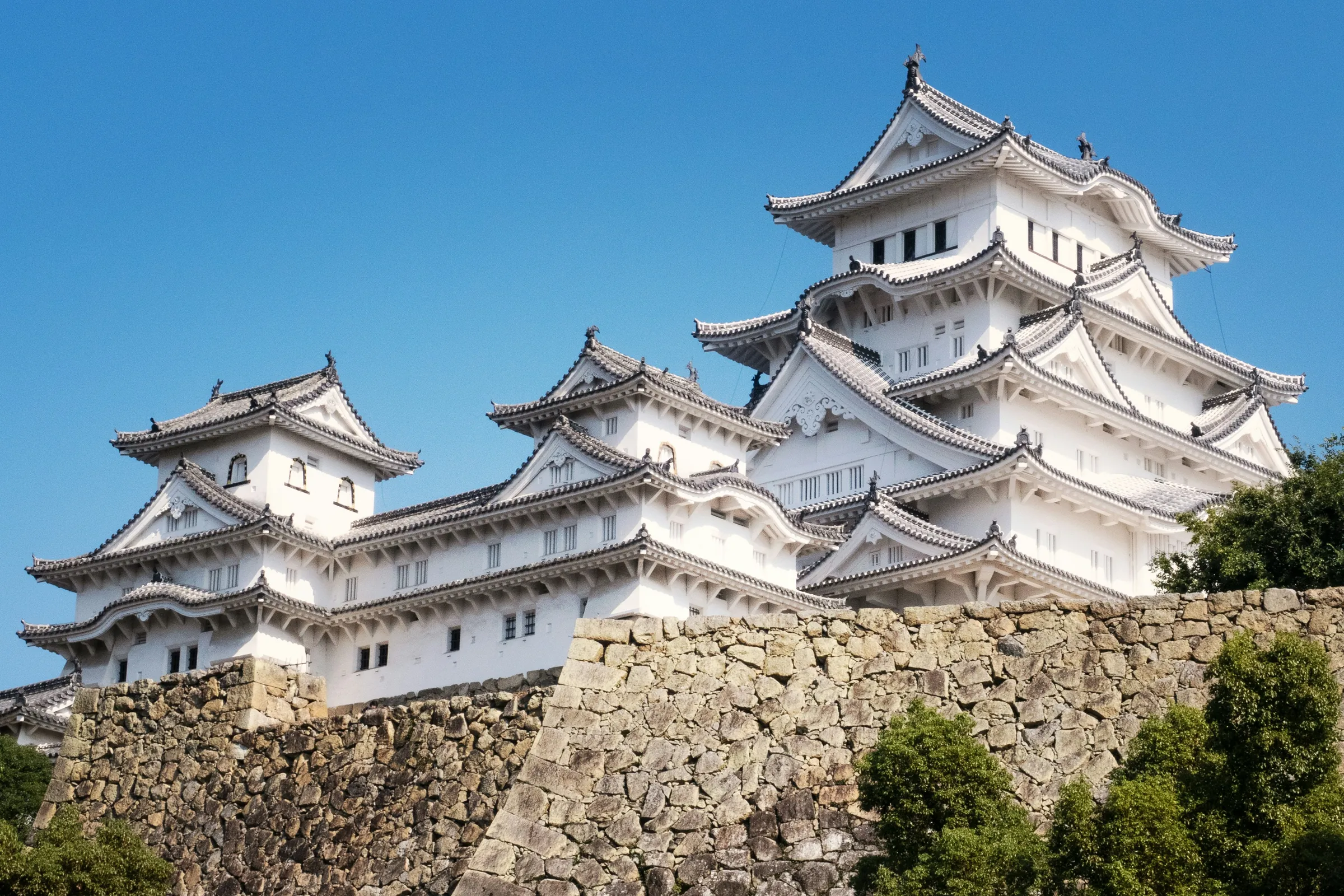
The great keep (daitenshu) is the reason most people come, and it is the real thing — a wooden tower completed in 1609, not a 20th-century concrete copy like the keeps at Osaka or Nagoya. It rises 46.4 metres and, in a typical piece of castle deception, looks like five storeys from outside while actually holding six floors above a basement. You enter through the basement, which once held a kitchen corridor and lavatories for a garrison under siege, then climb floor by floor: the vast first floor is a 'thousand-mat room' of more than 330 tatami, and each level shrinks as you rise, until the top floor is barely a tenth the size of the bottom.
You climb in your socks — shoes come off at the entrance and travel with you in a bag — and the staircases between floors grow deliberately steeper and narrower toward the top, an original defence meant to slow and expose any attacker who got this far. On the upper floors you can see the two great central pillars that carry the whole tower, and the framing of dark, worn timber that has held for over four centuries. The reward at the top is a small shrine and a window over the spreading white roofs and the city of Himeji beyond. Allow time: on busy days the narrow stairs back up inside the keep, and the descent is often done slowly, sometimes backwards.
The defensive design: the maze, loopholes and stone-drop windows
The walk up to the keep is itself a highlight, because it is a trap. The route spirals through a sequence of gates lettered in the old Japanese order — the i-gate, ro-gate, ha-gate and so on — each opening into a walled square, or masugata, where an attacker would be channelled, slowed and forced to double back while defenders fired down from every side. Paths that seem to point straight at the keep curve away from it; the imposing Hishi-no-mon, the 'Diamond Gate', and the later Nu-no-mon are checkpoints designed to break an enemy's formation. Walking it slowly, rather than rushing up, is how the genius of the layout reveals itself.
Set into the walls are roughly a thousand loopholes (sama), cut as circles, triangles, squares and rectangles, through which archers and matchlock gunners could fire on anyone trapped in the killing zones between the gates. Look too for the ishi-otoshi-mado — 'stone-drop windows' — overhangs built out from the walls and gates from which defenders could drop stones, or pour boiling oil, onto attackers pressed against the base below. None of this was ever tested in a full siege; the castle's defences were so complete that no army attempted them, which is part of why so much survives intact to be read today.
The Nishinomaru bailey and Princess Sen's corridor
On the western side of the complex lies the Nishinomaru, the west bailey, built in the 1610s by the lord Honda Tadamasa for his son Tadatoki and his daughter-in-law, Princess Sen (Senhime) — the granddaughter of the shogun Tokugawa Ieyasu, who came to Himeji after surviving the fall of Osaka Castle. The bailey is wrapped by the Hyakken Roka, the 'Hundred-Ken Corridor', a long timber rowhouse running some 240 to 300 metres along the rampart, lined with the small rooms where Princess Sen's ladies-in-waiting lived. You can walk its length in your socks, peering out through the same defensive windows that guarded the castle's weaker western flank.
At the corner of the corridor stands the Keshō Yagura, the 'Dressing Tower' or 'Makeup Turret', a turret said to have been given to Princess Sen for her own use. From the Nishinomaru you also get one of the classic views back across to the white keep, framed and slightly above you. Where the main keep is all military severity, the west bailey is the castle's domestic, human side — a reminder that this was a place where great families lived, not only a war machine, and a quieter loop that many hurried visitors skip.
The Hara-kiri Maru and the lesser-known corners
Tucked near one of the rear gates is the Hara-kiri Maru, an enclosure long pointed out to visitors as a place set aside for ritual suicide — seppuku — complete, in the old telling, with a platform, a witness's seat, and a well in which a severed head could be washed. It is a vivid story, and the spot has the hushed, shadowed feel to match it. Historians, however, lean toward a more prosaic truth: the structure was in fact one of the castle's important defensive posts, guarding the approach to a rear gate, and the grim legend grew up around it later.
Either way it is worth seeking out, as are the castle's other overlooked details. The thick white plaster that coats not just the walls but the eaves and roof tiles — the source of the name Shirasagi-jo, 'White Heron Castle' — was practical fire-proofing as much as beauty, and you can see it close up on the gates. Note too the family crests worked into the roof tiles by Himeji's successive lords, and the sheer scale of the stone bases (the Ikeda rebuild of 1601–1609 took an estimated 2.5 million man-days of labour). Slowing down for these small things turns a pretty white tower into a 400-year-old world.
Koko-en garden next door
Immediately west of the castle lies Koko-en, a set of nine separate walled gardens in the Edo style, opened in 1992 on the site of former samurai residences to mark the centenary of the city of Himeji. Each garden has its own character — a pond garden with carp and a waterfall, a tea-ceremony garden with a teahouse, a bamboo garden, a flower garden — linked by tile-roofed walls and gates that deliberately echo the architecture of the castle itself. It is calm, beautifully maintained, and rarely crowded even when the keep is busy, making a restful counterpoint to the climb.
For many visitors the single best photograph of Himeji's white keep is taken from within Koko-en, the tower rising white above the garden's trees and walls. Allow about an hour. The natural order is the castle first, while you have the energy for the steep climb, then Koko-en to wind down — and a combination ticket covering both is the obvious choice if you have half a day in Himeji. If you only have time for one extra stop after the keep, this is it: it adds the castle's softer, deliberate beauty to its hard military genius, in the space of a short walk.
Frequently asked
How many floors does the Himeji Castle keep have?
The main keep has six floors above a basement, though from outside it looks like five storeys — a deliberate piece of castle design. You climb all six in your socks up increasingly steep wooden stairs to a window over the city.
What are the loopholes in the walls of Himeji Castle?
They are sama — roughly a thousand firing slots cut as circles, triangles, squares and rectangles, through which archers and gunners could fire on attackers without exposing themselves. They are a key part of the castle's defensive design.
Who was Princess Sen at Himeji Castle?
Senhime (Princess Sen), granddaughter of the shogun Tokugawa Ieyasu, lived in the Nishinomaru west bailey after coming to Himeji in the 1610s. The Hyakken Roka corridor housed her ladies-in-waiting, and the Keshō Yagura 'Dressing Tower' is named for her.
What is the Hara-kiri Maru at Himeji Castle?
It is an enclosure traditionally said to have been set aside for ritual suicide (seppuku), with a well for washing a severed head. Historians now think it was more likely an important defensive post guarding a rear gate; the grim legend grew up later.
What is the Hyakken Roka at Himeji Castle?
The Hyakken Roka, or 'Hundred-Ken Corridor', is a long timber rowhouse around 240–300 metres long wrapping the Nishinomaru west bailey. It held the rooms of Princess Sen's servants and defended the castle's western side; you can walk its full length.
Is Koko-en garden worth visiting with Himeji Castle?
Yes — Koko-en is nine Edo-style walled gardens beside the castle, opened in 1992, and it offers one of the best views of the white keep. It is calm and uncrowded; allow about an hour, and a combination ticket bundles it with the castle.
What is the best order to see Himeji Castle?
Follow the climbing route up through the maze of gates to the keep first, while you have energy for the steep stairs, then loop through the Nishinomaru west bailey, and finish at Koko-en garden next door for the classic view of the keep.